Rebecca Schisler is a full-time core faculty member at the Institute for Jewish Spirituality, where she directs young adult programming and founded the Shevet Jewish Mindfulness Community. Rebecca has taught mindfulness for Or HaLev, Stanford University’s School of Medicine, Urban Adamah, and haMakom. Rebecca worked as the Shabbat & Ritual Lead at this summer’s Chavaya Music Festival and she also co-authored the Mahloket Matters Schools curriculum while serving as a senior social/emotional learning consultant at the Pardes Center for Jewish Educators. A rabbinical student at ALEPH, Rebecca is passionate about integrating ancestral wisdom traditions with innovative approaches to personal and collective healing and liberation. She teaches Jewish spirituality as an embodied, transformational, and accessible path, with relevant and timely wisdom for all. Rebecca earned her BA in Studio Art from Wesleyan University.
The Covenant Foundation: What makes you proud about your work with the Shevet community this past year, and how are you scaling its unique model of Jewish mindfulness?
Rebecca Schisler: It has been an incredible year of growth for Shevet! As Director of Young Adult programming at the Institute for Jewish Spirituality, I supported the launch of Shevet Jewish mindfulness collectives in two new hubs: Brooklyn and Cambridge. These joined our original East Bay, California collective, which has been thriving for four years.
These are in-person, peer-led communities for people in their 20s and 30s who meet weekly to practice Jewish mindfulness. Building on this momentum, we are expanding this fall into three more cities: San Francisco, Minneapolis, and West LA.
To fuel this expansion, I wrote and am publishing a Shevet guidebook through IJS. We also expanded our online programming and hosted our third annual 5-day Shevet meditation retreat, which completely sold out at 45 participants.
The Covenant Foundation: How will the new guidebook will equip and empower local Jewish mindfulness communities?
RS: The Shevet guidebook is designed to share the “magic” that makes our communities unique, allowing new leaders to scale the model without needing to reinvent the wheel. My hope is that a new host in any city can open this book and immediately find the tools to hold a weekly meditation sit confidently.
The guidebook provides:
- Curriculum Inspiration: Creative themes grounded directly in Jewish practices and the natural rhythms of the Jewish calendar.
- The “Nuts and Bolts”: Step-by-step logistical guidance on how to hold a sacred, mindful Jewish space.
- Cohesive Best Practices: Sourced materials that ensure new, independent groups remain coherent with broader IJS programs.
And ultimately, it gives facilitators cultural depth and structural framework so they can focus entirely on building local connection.
The Covenant Foundation: We know that you also recently served on the core team for the inaugural Chavaya Jewish Music Festival. Can you tell us more about this event?
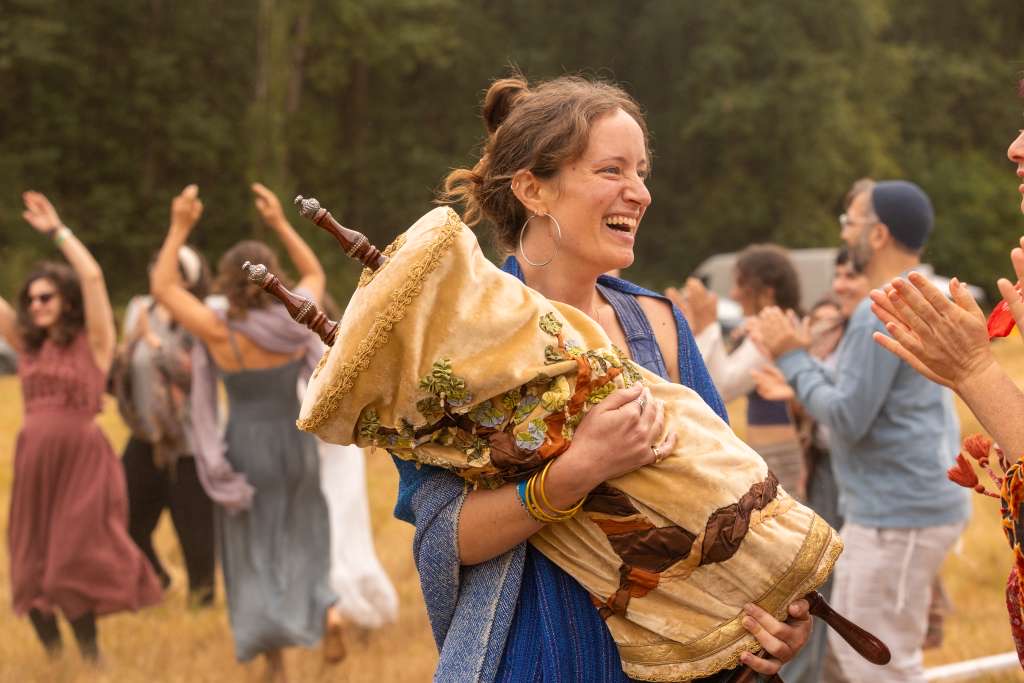
RS: Chavaya is an earth-based, family-friendly Jewish music festival held in Duvall, Washington, rooted in the living landscape of the Pacific Northwest. Its mission is to create a vibrant, inclusive, and sacred gathering where Jewish wisdom, ecological awareness, and embodied spirituality intertwine.
The Covenant Foundation: Who attended Chavaya, and what did the experience look like for the participants?
RS: The four-day gathering brought together over 300 participants, alongside spiritual leaders, artists, and workshop facilitators. It was beautifully intergenerational and drew a unique mix of people: local Seattle-area synagogue members experiencing earth-based, embodied spirituality for the very first time, alongside seasoned music-festival regulars discovering the raw spiritual vibrancy of Judaism.
The schedule wove together music, workshops, Shabbat observance, art, and nature connection. We had incredible featured musicians performing, including Eliana Light, Rabbi Yosef Goldman, Aly Halpert, and others closely connected to the community. Many attendees walked away describing the entire weekend as genuinely transformative.
The Covenant Foundation: What was your specific role at Chavaya, and what did you teach in your workshop?
RS: I served on the Core Team as the Shabbat & Ritual Lead, where I oversaw the container for our rituals, led several prayer services, and facilitated a dedicated workshop.
My workshop offered a mindfulness-based introduction to the Four Worlds of Kabbalah (Asiyah, Yetzirah, Beriah, and Atzilut). We explored this mystical anatomy as a highly practical, spiritually rooted framework that participants can use in modern life to cultivate deeper awareness, presence, and compassion across every dimension of their day-to-day experiences.
The Covenant Foundation: Can you share how receiving the Pomegranate Prize affected your professional path and goals?
RS: Receiving the Pomegranate Prize has been a powerful affirmation that devoting my career to innovating Jewish education through spirituality and mindfulness was the right choice. Whenever I have self-doubt or feel small in my leadership, or worry that the work I’m doing is too “out there” or against the grain of the mainstream world, remembering that I’m part of the Covenant family is extremely encouraging and uplifting. It’s a reminder that what I am doing matters, and is impacting people in a beneficial way. Receiving this prize helps me to feel inspired to continue pouring my heart and soul into my work, trusting that I’ll be supported and resourced along the way.
It has also been such a gift to gather throughout the year with my Pom Prize cohort and the Covenant network — it’s special to share space with other Jewish educators who are deeply passionate about what they do. The heart and soul of the work feels vibrantly alive, and I appreciate the feeling of camaraderie — none of us are alone in our work of carrying on Jewish wisdom to the next generations. We are in it together, each coming from unique vantage points and holding important pieces of the puzzle.
Read more from Rebecca: