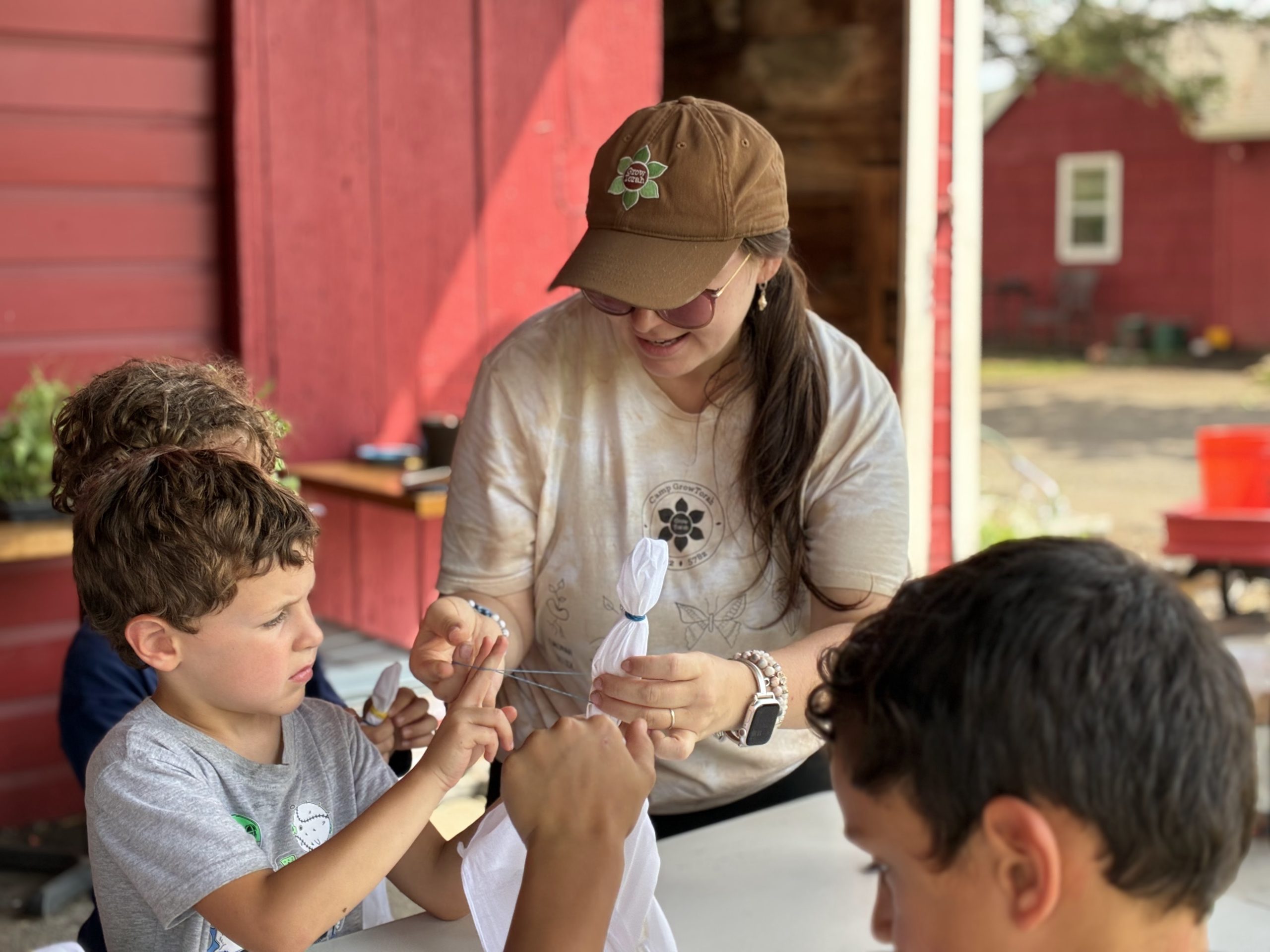
Menuchah Schuman Hirschman is a senior garden educator at GrowTorah, where she develops creative lessons that intertwine Torah, environmental stewardship, and outdoor education to bring Jewish learning to life through hands-on experiences in nature. Menuchah also serves as a teacher at Zeman Religious School in South Orange, New Jersey. Before joining GrowTorah in 2022, she participated in the MafTEACH School Community Fellowship through the Azrieli Graduate School of Jewish Education at Yeshiva University. Menuchah earned her master’s degrees from Yeshiva University’s Graduate Program in Advanced Talmud/Tanach Studies and the Azrieli Graduate School of Jewish Education. She received her undergraduate degree in Jewish Studies and Education from Stern College for Women, where she was a Monique Katz Scholar and received the Rabbi Chaim Levine Memorial Award for Excellence in Jewish Studies.
The Covenant Foundation: Can you share with our readers a bit about the core mission of your work as a Jewish environmental educator?
MS: In my work, I focus on bringing Torah to life through experiential environmental education. By teaching through gardening, farming, cooking, and exploring the natural world, I help students deepen their connection to Torah, the land, one another, and Hashem.
The Covenant Foundation: You were recently promoted. What does your current role at GrowTorah look like?
MS: Yes! I was promoted to Senior Garden Educator at GrowTorah. In addition to teaching, I also mentor GrowTorah Anafim Teachers and manage The GrowTorah Thymes newsletter.
The Covenant Foundation: Can you share with us about some of the programs you facilitated during the 2025–2026 school year?
MS: This past year, I taught across several school communities, adapting programs to the seasons. In the fall and early spring, I taught students in the outdoor gardens at Yeshivat He’Atid & SAR. In the winter, I led an indoor microgreen program that I originally developed several years ago and continue to refine.
The Covenant Foundation: SAR Academy’s garden program has a unique history. Can you share more about your work at Gan Ilan?
MS: Sure. Gan Ilan is named in memory of Ilan Tokayer, who had a deep love for the earth, and his family generously funds the program in his honor. This past year, I expanded several programs there:
- Farm to Table Curriculum: I designed a new seasonal, hands-on cooking experience for 3rd and 5th graders. We connected the produce of the moment to the weekly parsha or upcoming chagim—exploring everything from Rosh Hashanah apples and pomegranates to Pesach fruits.
- Forest & Garden Lessons: I taught 1st, 2nd, and 4th graders in both the garden and forest. Lessons connected Jewish values to the natural world, ranging from forest stewardship to planting seasonal crops like garlic, wheat, and parsley.
I also led programs at the Mercaz Academy, implementing the GrowTorah curriculum in the fall and spring. A major highlight was exploring kilayim (hybrid planting) and orlah (laws regarding young trees) as we planted two new fruit trees.
The Covenant Foundation: Can you share a bit about some of the new educational methodologies you’re employing in your work as a garden educator?
MS: Teaching in the forest at SAR inspired me to investigate Forest School programs in Europe. I am using some of my Pomegranate Prize funds to explore how these programs use the outdoors as a consistent learning environment to foster independence, creativity, and problem-solving.
I am fascinated by the idea of using nature not just as a pretty setting for a lesson, but as a meaningful part of the learning itself. I’m currently exploring how these European models can be adapted directly to Jewish environmental education.
The Covenant Foundation: How has winning the Pomegranate Prize impacted your professional and personal journey over the past year?
Menuchah Schuman: This past year has been particularly meaningful. The Pomegranate Prize has opened new questions and possibilities, giving me the encouragement to keep developing my work and the opportunity to step back and think about where I want to take it next.
The Covenant Foundation: And finally…you experienced a major personal milestone this spring! How has that transition been?
MS: Yes! In May, I gave birth to my daughter, Noa. Returning to work after having her has started a brand-new chapter. It is incredibly special to continue doing the work I care so much about while navigating this new season of life.
Read more from Menuchah: