
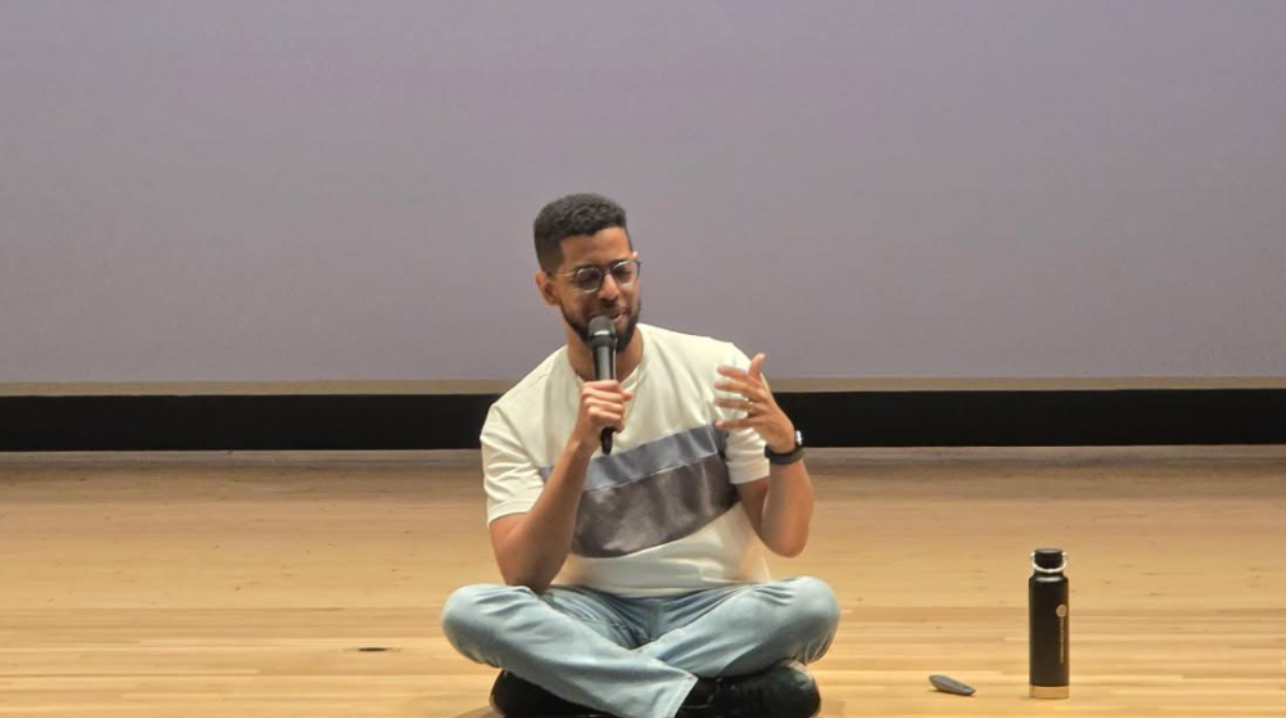
Rabbi Kendell Pinkney serves as the Director of Education and artist-in-residence at Reboot, a Jewish arts and culture nonprofit. Additionally, he is the founding artistic director of The Workshop—an arts and culture fellowship for emerging creatives of BIPOC- Jewish heritage. A frequent keynote speaker, he was among the first rabbis honored to offer a multifaith invocation for the 110th First Lady’s Luncheon, honoring Dr. Jill Biden. He is the recipient of a 2023 IDEA Residency at Opera America and was selected for Theater J’s “Expanding the Canon” commission program. Kendell earned his Rabbinic Ordination and MA from The Jewish Theological Seminary, where he was a Wexner Graduate Fellowship/Davidson Scholar, his MFA in Musical Theatre Writing from Tisch School of the Arts at NYU, and his BA in Religion and Jewish Studies from Oberlin College.
The Covenant Foundation: How have your professional goals evolved since receiving the Pomegranate Prize?
Rabbi Kendell Pinkney: Since receiving the Prize, I have collaborated with my mentor to continue exploring my interest in education research on Jewish arts and culture, and non-formal, adult Jewish learning groups of Color. As a result, I will be starting a PhD in Curriculum and Pedagogy at University of Toronto’s Ontario Institute for Studies in Education in fall 2027. I was able to bring a small taste of these deepening interests to several hundred Westchester County Public School students in a series of Jewish American Heritage Month presentations in May 2026.
The Covenant Foundation: Can you tell us a bit more about the presentations you did for students in Westchester? What were your takeaways from those sessions? What are public school students curious about, what kinds of questions did they ask, and how should that inform the work we are doing in the field?
KP: Over the month of May 2026, I presented ten one-off sessions across five schools to teachers and students ranging from grades 6th to 11th. The sessions began with a short performance of a personal monologue of my experience as a Black Jewish person. Afterward, I gave a short presentation on “highlights” from Jewish American history and present-day Jewish communal realities (e.g., Jewish racial and ethnic diversity, creative and social contributions to American society, micro-recommendations for how they can counter antisemitism).
The Covenant Foundation: How did students and faculty react to your presentations? What were they curious about?
KP: During the Q&A section of each presentation, students and teachers alike were incredibly curious to learn more about my journey toward becoming a rabbi. Moreover, they were excited to hear me chant a bit of Torah and learn about comparative religious differences between Jewish and Christian communities. Individual students and teachers—including several Jews of Color—approached me after the presentation to express their gratitude.
The Covenant Foundation: Upon reflection, what were your greatest learnings from this experience?
KP: The greatest learning I took away from these presentations is that young people are eager and open to learning about Jewish ritual and culture, especially when the learning is communicated to students via performing arts and creativity. Additionally, several students and teachers expressed gratitude that I focused more on pro-social contributions of Jews in America than on antisemitism, the wars in the Middle East, or the Holocaust.
The Covenant Foundation: Any final thoughts about your experience as a Pomegranate Prize recipient?
KP: The Pomegranate Prize has had an outsized impact on my evolution as a Jewish educator. While I have long seen myself as deeply invested in the work of experiential Jewish education, especially as it relates to arts and culture and Jews of Color, receiving incredible mentorship and encouragement from my cohort through Covenant propelled me to expand my ambitions around what I might do with this passion for Jewish education. In my case, I was able to devote significant resources to exploring and pursuing doctoral work in arts and education at the University of Toronto. What is more, I now have a wonderful cohort of colleagues I can call on when I need to think through new directions in my work and research.
Read more from Kendell:
Expanding the Canon Highlights Six Diverse Jewish Plays | Moment Magazine
As a Black rabbi, I’m still processing Kanye West’s hate speech | The Forward