
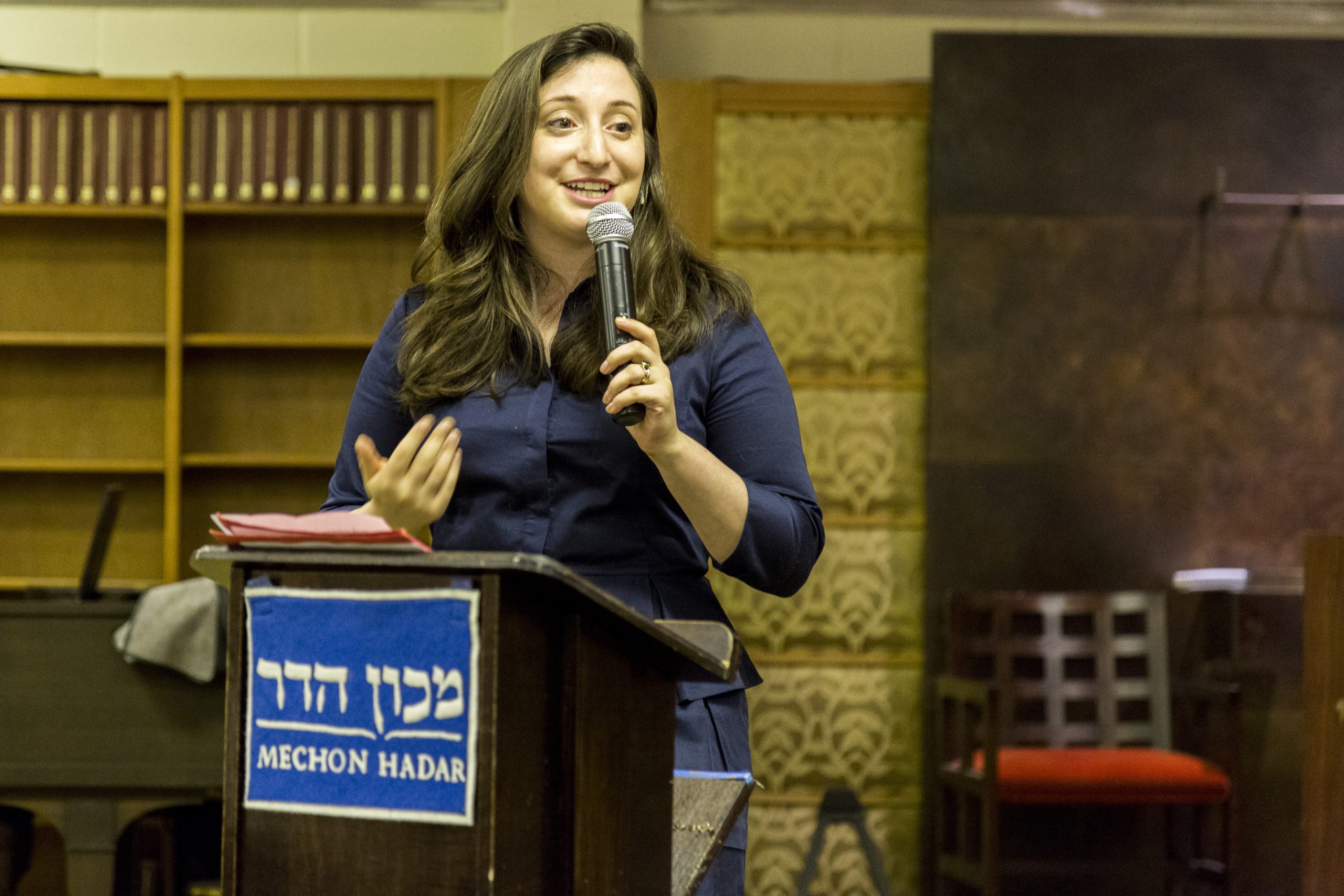
Rabbi Tali Adler is a faculty member at The Hadar Institute, where she teaches Talmud, Tanach, and parshanut to college students and adult learners. She also mentors students in Hadar’s Advanced Kollel program and Summer Beit Midrash. She recently helped develop Hadar’s new Mekhinah program, a new course of study for future Jewish educators and leaders starting this fall. Tali has taught at several institutions, including Harvard Hillel, Kehilat Rayim Ahuvim, Drisha, and BBYO. In addition, she served as a chaplain intern at New York-Presbyterian Hospital, where she provided emotional and spiritual support for staff, patients, and families. She received S’michah (Rabbinic Ordination) from Yeshivat Maharat, where she was a Wexner Graduate Fellow. She earned her BA in Jewish Studies and Political Science from Stern College for Women’s S. Daniel Abraham Honors Program at Yeshiva University, completing the thesis, “Blood, Margins, and Danger: Menstrual Purity Laws and Spanish Crypto-Jewish Women in Early Modern Spain.”
The Covenant Foundation: What have you been focusing on recently in your work and personal life?
Rabbi Tali Adler: I’ve primarily spent my time writing, teaching, and helping to develop Hadar’s new Mekhinah program. I also developed a course on Brit Milah called “Entering the Covenant” for Hadar’s Project Zug.
Outside of my institutional work, I have started an Instagram account (@r.taliadler/) to share Torah snippets and have published a few pieces with Recharge. I was also deeply touched to be included on Unpacked’s list of “14 Women Rabbis Shaping Jewish Life Right Now.”
On a personal note, I recently gave birth to a baby girl, Devi Elizabeth, and am currently spending my parental leave enjoying her and adjusting to our new life as a family of five.
The Covenant Foundation: What motivated you to start sharing Torah snippets on social media?
TA: I began sharing small pieces of Torah on Facebook a few years ago. I started after October 7th to use Torah to process the tragedy, and I continued sharing weekly throughout that year.
What I discovered is that people are truly hungry for Torah that they can encounter and interact with naturally, right alongside the other content filling their social media feeds. This year, I am dipping my toes into Instagram. There is a lovely, burgeoning Torah community growing there, and I am excited to see what I learn on this new platform.
The Covenant Foundation: Can you tell us about Hadar’s new Mekhinah program and why it is so critical?
TA: The Mekhinah program is a new Hadar initiative launching this fall. It is a year-long program designed for aspiring rabbinical students, Jewish educators, and other Jewish professionals who need foundational text skills and Torah education to prepare them for academic programs.
We all know there is a rabbinic pipeline problem out there. We believe the issue isn’t a lack of young people who want to serve the Jewish community; rather, it’s that many of them don’t have the prerequisite education required to start rabbinical school. After our first week, I am most excited about the incredible caliber of the students enrolled and how deeply they want this learning. It is a true honor to play a small part in what I know will be beautiful journeys in Torah and Jewish education.
The Covenant Foundation: Where can people listen to your recent deep dives into Jewish thought?
TA: You can listen to the episode “What is Obligation?” on Hadar’s podcast, Answers With Held. In that episode, Rabbi Shai Held and I explore one of the most provocative images in rabbinic tradition: the idea that at Sinai, God held a mountain over the Israelites’ heads to threaten them into accepting the Torah. We use that text to dive into deep questions regarding obligation, autonomy, commitment, and love.
The Covenant Foundation: Can you share thoughts on what the Prize has meant to you, and what the Pomegranate Prize cohort experience has added to your professional development?
TA: The Pomegranate Prize gave me encouragement. In a moment where so many Jewish professionals are feeling burnt out and unsure, encouragement means everything. Being selected for the Prize reinforced that the work that I’m doing in the world is valuable and pushed me to dream about my career in a bigger way. I don’t know exactly what my next steps are going to be yet, but I do know that they will be braver because of my experience with the Pomegranate Prize.
I think the best things that came out of being part of this cohort were similar: getting to know so many exceptional, driven, kind, and humble Jewish educators in similar career stages was imagination-expanding. It showed me just how broad the Jewish education world is, and pushed me to broaden my personal horizons, both as a Jew and as a Jewish Educator.
I’m truly blessed to work in the beit midrash oriented sector of Jewish education. And, sometimes, the all-consuming nature of that work makes it hard to see beyond that particular horizon. Being part of this cohort helped me rediscover parts of me that don’t traditionally find themselves in the beit midrash and dream about how I can bring them back into my life and my work.
Read more from Tali: