
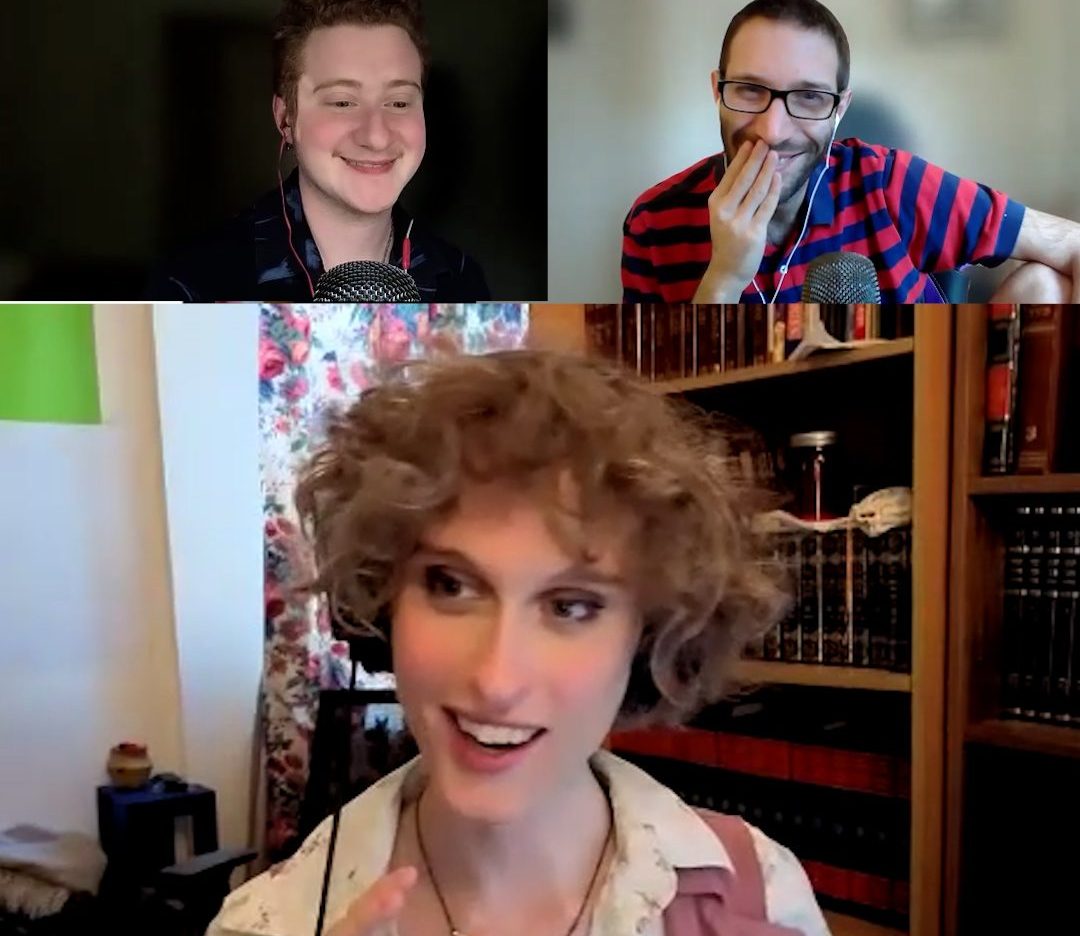
Lexi Kohanski is a trans Jewish educator who focuses on empowering those who have not felt at home in Judaism. She is a thought leader in the realm of trans Torah, and served as director of online learning at The Torah Studio. She is currently studying at Yashrut for her rabbinic ordination. Her first publication, Be Whole: A Halakhic Approach to Gender and Transition, laid out a pathbreaking halachic framework for relating to Jewish gender transition as a sacred undertaking. Lexi has given talks on the trans Jewish experience at synagogues across the United States and in Scotland, as well as on her podcast, Torah for Trans Lives. Lexi earned her BA in Communications and Slavic Studies from Northwestern University and has also studied at the Conservative Yeshiva, Pardes Institute of Jewish Studies, SVARA: A Traditionally Radical Yeshiva, The Hadar Institute, Yeshivat Maharat, and Yashrut.
The Covenant Foundation: In the past year since you received the Pomegranate Prize, you’ve launched two major projects that rethink how Jewish educators teach traditional texts. Starting with your work at The Torah Studio- How did you manage to teach advanced “discursive” Talmud skills entirely in English?
Lexi Kohanski: Traditionally, parsing a text, identifying Talmudic terminology, and constructing the flow of a complex argument are thought to require total fluency in Hebrew and Aramaic. I wanted to challenge that assumption. I taught 16 students these exact skills entirely in English using hyper-literal translations. By removing the immediate barrier of the dictionary, students spent less time struggling with vocabulary and more time diving into deep content. In the end, their analyses were completely equivalent to what we expect in traditional, beginner-level Talmud courses.
The Covenant Foundation: Your second project takes a very different and highly creative approach to language learning. Can you share a bit about Worlds To Come?
LK: Worlds To Come is the first and only tabletop roleplaying game where you learn Hebrew as you play. The real challenge was balancing two distinct goals: it needed to be pedagogically excellent—reflecting the best modern research on second-language acquisition—while also being an incredibly fun, engaging game on its own. I think I pulled it off, but players can now judge that for themselves! The Kickstarter to publish the Worlds To Come book and “oracle” deck launched after the High Holy Days, and I plan to partner with synagogues to run the game for teens as experiential programming in Hebrew and Jewish values.
The Covenant Foundation: Beyond these pedagogical innovations, what else have you been diving into this year?
LK: It’s been a very full year! I’ve begun intensive halakhic study for rabbinic ordination at Yashrut, started learning Yiddish, and was recently published in Returning Higher: Hasidic & Neo-Hasidic Inspiration for the High Holy Day Journey. I also had the privilege of teaching trans Torah to queer Orthodox Jews and their parents at two separate Eshel retreats.
The Covenant Foundation: You’ve also been writing a neo-traditional Torah commentary called the Em haBanim. While it isn’t published yet, you recently shared a translated excerpt tackling Leviticus 18:22—one of the most challenging verses in the Torah for queer Jews. Can you share a bit more about your writing?
LK: Yes! You mentioned I translated that excerpt—I write this commentary in traditional, classical Hebrew. Let me read you that excerpt. It begins with the section of Torah that prohibits queer sex:
And you shall not bed a man with the beddings of a woman (Leviticus 18:22). … Queer Jews’ refusal to accept these prohibitions is not a flaw in our acceptance of the Torah. Rather, by throwing off the yoke of these prohibitions, we make possible the fulfillment of the entire Torah and the manifestation of the Creator’s Presence on Earth. For on the one hand, What is hateful to you do not do to your fellow; that is the entire Torah (Shabbat 31), and if we were to accept the Sages’ interpretation of this verse, it would turn out that they, the Sages, would be doing to us what is hateful to them, such that our Sages would have failed to fulfill the whole entire Torah, God forbid…
Without rejecting the traditional interpretation of these painful verses, I’m trying to upend our relationship with them. But I’ll leave it to you to take your own meaning from what I wrote.
The Covenant Foundation: As you embark on your rabbinic studies, what’s your dream for anyone who hopes to follow in your path?
LK: I feel privileged to learn halakha at such a high level as an openly trans woman. As I begin my own rabbinic journey, I hope to learn and teach in such a way that in two generations it will be taken for granted that trans Jews have a home in the Torah—and that it no longer needs to be the work of a lifetime to get our halakhic traditions to speak to us as our full selves.
The Covenant Foundation: Can you share with readers what you most enjoyed about being a Pomegranate Prize recipient?
LK: Far and away, I have most enjoyed becoming part of the Covenant family. The mentorship I received from Dr. Jane Shapiro has permanently improved my craft as a teacher. The connections I’ve made at the Awards ceremonies and retreats have led to opportunities for work, growth, and cross-pollination. Since the bulk of my career has unfolded virtually, it has transformed even my day-to-day experience to gain such a deep and extensive network of Torah educators.
Read more from Lexi:
Episode 546: Worlds to Come – Lexi Kohanski | Judaism Unbound Podcast