ARTICLE Where Democracy Begins: Teaching Dialogue, Courage, and Civic Responsibility
By Yali Szulanski
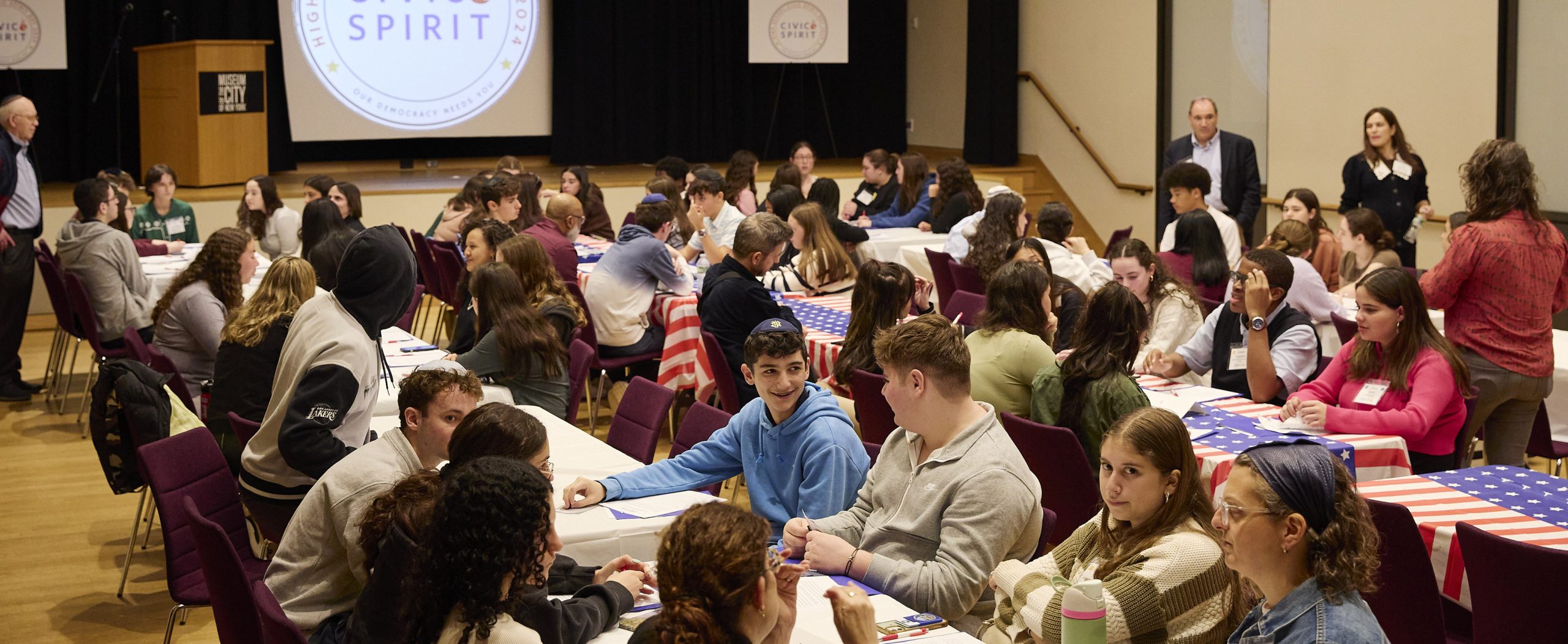
In Nina Cohen’s U.S. History classroom at Frisch High School, a chart hangs on the wall. Students have filled it with the norms they decided were necessary for real conversations: how to speak with care, how to show they are listening, how to disagree without turning against one another. Nina, who has benefited from training through Civic Spirit, refers to the chart often, especially when the discussion moves into topics that feel complicated or personal.
Scenes like this are not incidental to Rabbi Charles E. Savenor. As Executive Director of Civic Spirit, and a grantee of the Covenant Foundation, he sees these moments as small but essential steps toward a healthier civic culture. He works with schools that want their students to learn the habits of democracy in real time, not someday in the distant future. His work focuses on the belief that students learn democracy by practicing it, not memorizing it. Dialogue and responsibility deserve proper time and structure to grow.
I came to this conversation as both an interviewer and a practitioner. As an educator who partners with schools and community organizations to train teen leaders and facilitate dialogue, and as a recipient of the Covenant Foundation’s Pomegranate Prize, my work focuses on helping teens and teachers navigate disagreement with clarity and care. In classrooms, youth programs, and school-wide settings, I support students in learning how to speak honestly, listen generously, and remain in relationship when conversations become charged. I also work closely with educators, many of whom feel the weight of guiding difficult discussions without enough tools or support.
It was from this shared ground that I sat down to interview Savenor. Again and again, I heard echoes between Civic Spirit’s approach and my own work in schools: a belief that young people are capable of more than we often give them credit for, and that avoiding hard conversations does them a deep disservice. “We are helping students find their voice, build connections, and make thoughtful decisions about the kind of society they want to live in,” Savenor told me.
Young people rarely witness productive disagreement, and they are seldom guided through it. Students want to speak honestly with their peers. They want to understand what fairness looks like in real time. They want to know they belong in the conversations shaping their communities. Teachers feel this pressure too. They want to guide students through moments that matter, yet often feel unprepared to do so alone.
What Students and Teachers Are Facing
Civic Spirit emerged from a concern that civic dialogue in the United States had grown thin. Polarization seeped into family dinners, classrooms, and daily communal interactions. Early research from Civic Spirit revealed declining civic knowledge, rising feelings of helplessness, and teachers who wanted to open meaningful conversations but did not feel equipped to guide them.
Savenor spends considerable time thinking about these realities. He notes that telling America’s story has grown more complicated: different groups argue about which version should be taught. Students often encounter simplified narratives that portray the country as entirely admirable or deeply broken.
“The American story contains moments of courage and moments of pain,” he says. He believes students can hold the fuller story when given tools to explore.
Teachers also need practical tools. Through my own work with schools, I see how even small language frames can reshape a conversation. Even a sentence stem like, “I see it differently,” can give a child enough space to disagree without fear, and make difficult conversations feel more manageable.
Head, Heart, and Hand
Civic Spirit organizes its work around three strands: democratic fluency, civic skills, and civic attitudes.
Democratic fluency begins with primary sources. Students work directly with documents that shaped American life, such as the Declaration of Independence, the Constitution, or Martin Luther King Jr’s Letter from Birmingham. They annotate, question, and imagine themselves inside the dilemmas these documents address. Hands-on interaction strengthens their grasp of history, and improves their ability to identify the ideas they want to protect.
Civic skills focus on the practice of dialogue. Teachers in Civic Spirit cohorts learn protocols that make room for careful, structured conversation. Students take turns, ask clarifying questions, and reflect back what they heard before responding. Students learn how to be curious, rather than defensive.
Civic attitudes address students’ sense of belonging in this country. One of Savenor’s favorite exercises invites students to trace their families’ arrival in the United States. Rediscovering these stories often helps students appreciate the possibilities their families sought and the responsibilities they now carry.
Savenor often reminds students that a strong democracy protects minority communities. For the Jewish community, this truth carries weight. It encourages students to learn their rights, recognize their voice, and engage with neighbors whose backgrounds differ from their own.
From “Days Off” to “Days On”
Several of the clearest examples of Civic Spirit’s impact come from stories inside partner schools.
At Bornblum Jewish Community School in Memphis, TN, educators recognized that civic holidays on their calendar functioned mainly as time off. Once they joined Civic Spirit’s cohort, they chose three holidays each year to reimagine as “days on.” Students and teachers use these days to explore civic themes, reflect on shared responsibility, and engage with the wider community. The shift changed the culture of the school. These days are now widely welcomed, rather than thought of as interruptions.
At Golda Och Academy in New Jersey, Rabbi Shira Johnston teaches American law in conversation with halakha. Her class engaged in a nuanced study of abortion through both legal traditions. She used dialogue protocols from Civic Spirit to help students talk through what they learned. The structure allowed students to hear one another without fear and discover that respectful disagreement strengthens understanding.
Civic Spirit’s student clubs, supported by a Covenant Foundation Ignition Grant, offer another window into this work. Clubs choose a local issue and design a project that reflects their school’s needs. Students at Yavneh Academy in New Jersey began the year with frustration: their school library had been converted into a classroom due to growth. The Civic Spirit club created a space for students to share concerns and propose solutions. The process taught students how to speak up, listen to constraints, and collaborate with peers and administrators.
Preparing the Next Generation to Swim
The Talmud instructs that parents must teach their children to swim; preparing children with this life skill is essential. Savenor often returns to this idea. When he talks about preparing students for civic life, he speaks with the same sense of care. Students step into choppy waters full of disagreements and questions without simple answers, and they need strokes they can rely on.
“Hope carries me forward,” he says. “The last few years have brought painful moments of antisemitism into my world. Even with those experiences, I hold tightly to the idea that understanding can grow, and dialogue can soften what feels rigid.” He often refers back to the idea that education is the steady work that keeps the next generation from sinking into fear or disconnection.
Savenor often speaks about our responsibility to those who come after us. “Moses spends his life preparing the Israelites for a future he will not enter,” he says, returning to the image not as tragedy but as calling. For him, this is the heart of education: work rooted in trust rather than control, patience rather than certainty. “We teach toward horizons we may never see,” he continues, “with the faith that our students will carry the work forward—building communities, institutions, and civic life in ways we cannot yet imagine.”
Democracy grows through these small acts of learning and courage. Civic Spirit creates spaces where these moments can unfold. Students learn how to listen, how to steady themselves, how to remain curious, and how to recognize one another as partners rather than opponents. These are skills they will carry long after they leave the classroom and will keep them moving toward a future they will one day shape.

Latest Volumes
Past Volumes




Built On the Roots of Tradition: New Models in Jewish Supplementary Education